Last updated: 16 September 2026
If you’re looking into cleaning services in KL, you’ve probably got three questions: what it costs, how often you actually need one, and how to tell a legitimate company from a risky one.
This guide answers all three of them.
Short answer: Standard cleaning services in Kuala Lumpur typically cost RM80–RM200 per session, with deep cleaning running RM250–RM400+. Most KL homes benefit from a weekly clean, and there’s a genuine local reason for that — Klang Valley’s humidity regularly sits well above the level at which mould becomes a real risk. Details, sources, and a way to actually verify a company’s registration are below.
Table of Contents
Cleaning Services KL: How Much Do They Cost?
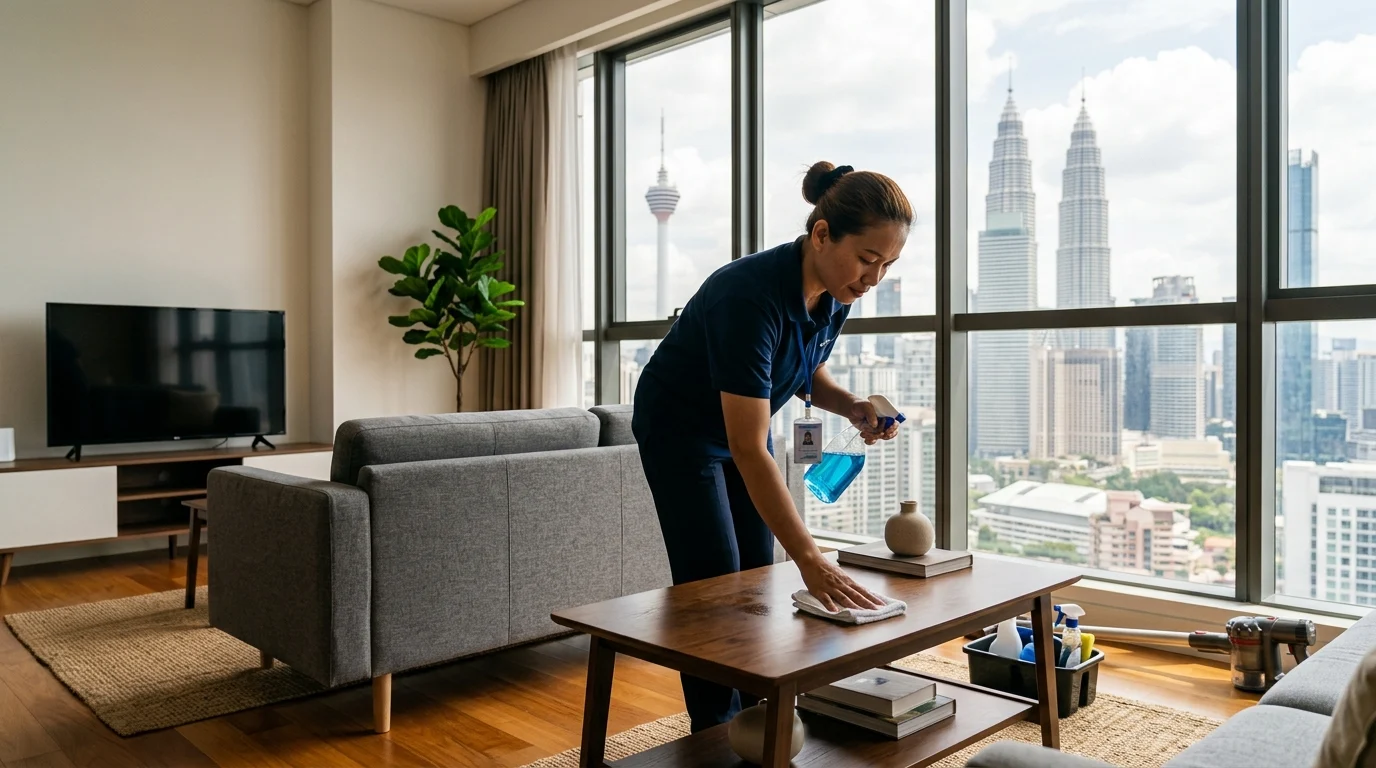
General market pricing for cleaning services in Kuala Lumpur runs RM80–RM150 for a small apartment, RM100–RM200 for a standard weekly session, and RM300 and up for a full deep clean, according to a Kuala Lumpur cleaning-cost breakdown by home-and-lifestyle site Dig This Design. What actually moves the price:
- Home size — more square footage means more time, which means more cost.
- Dirt/mess level — a first-time or overdue clean takes longer than routine upkeep.
- Frequency — recurring bookings are often priced more favourably per visit than one-off jobs.
- Add-ons — windows, carpets, and other extras are typically billed separately from the base session.
A real local example: Top Clean & Clear, a Petaling Jaya-based provider covering Kota Damansara, Bandar Utama, TTDI, Bangsar, and selected KL areas, charges a flat RM130 for a standard 4-hour session, with no advance payment — you inspect the work and pay after it’s done. Full scope and coverage details are on their house cleaning service page.
How Often Should You Clean Your Home in KL?
Most general cleaning guidance — vacuum and dust weekly, wash bedding weekly, wash curtains monthly — comes from the American Cleaning Institute’s allergen-control recommendations, which notes that “a regular routine is more effective than occasional deep cleaning” for keeping dust and allergens under control. That’s sound advice anywhere, but Kuala Lumpur has a specific local reason to take it seriously.
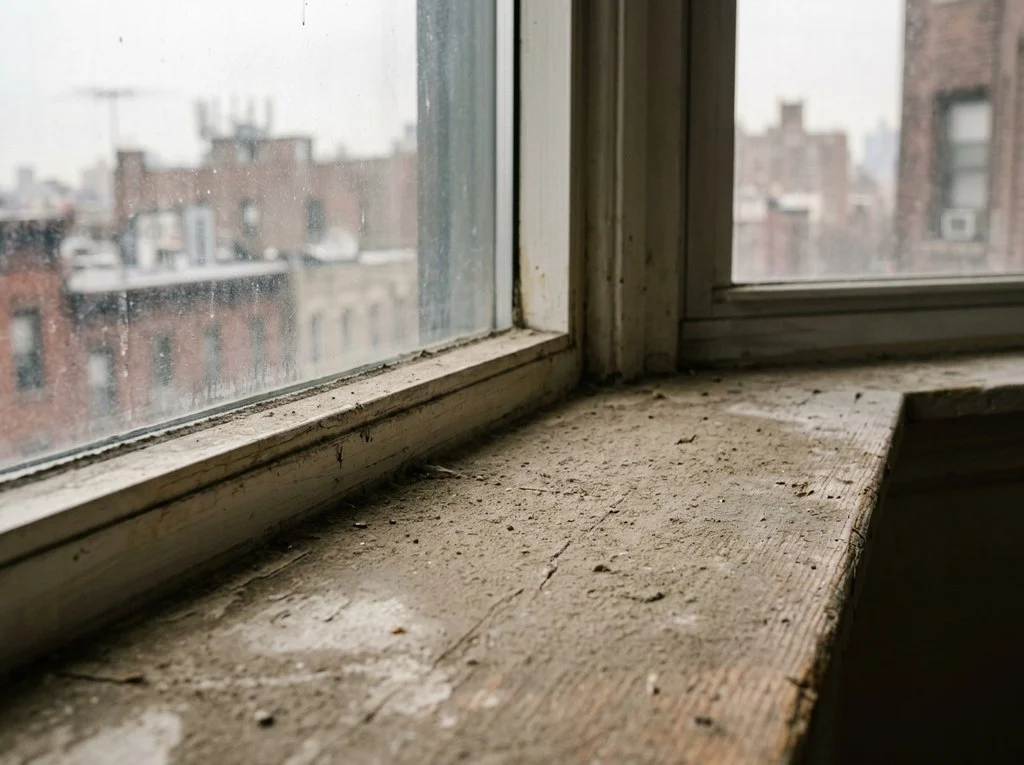
KL’s humidity is genuinely high enough to matter. Peninsular Malaysia’s mean relative humidity runs 80–88% year-round according to MetMalaysia’s own climate data, with daily maximums regularly exceeding 94%. Compare that to the US EPA’s mould-prevention guidance, which recommends keeping indoor relative humidity below 60% — ideally 30–50% — to prevent mould growth. KL’s ambient humidity sits well above that threshold most of the year, which is a genuine, physical reason homes here need more frequent cleaning and ventilation than a drier climate would require, not just a generic “clean more” recommendation.
Haze season adds a second, seasonal factor. During dry-season haze episodes, Klang Valley air quality can deteriorate sharply — as recently as August 2026, several Klang Valley stations (Shah Alam, Petaling Jaya, Batu Muda) recorded “Unhealthy” Air Pollutant Index readings above 150, per Malay Mail’s reporting. Fine particulate matter from haze settles indoors through open windows, air-conditioning intake, and normal foot traffic, which is one reason many KL households increase cleaning frequency specifically during haze periods rather than keeping a flat year-round schedule.
A simple rule of thumb:
| Home type | Baseline | During haze episodes / high-humidity stretches |
|---|---|---|
| Condo/apartment | Weekly | Consider light mid-week dusting/vacuuming |
| Landed house | Weekly, or twice weekly with kids/pets | Same, plus more frequent window/sill wiping |
A worked example: a condo unit near a main road in areas like Bandar Utama or TTDI tends to accumulate dust faster than a similarly-sized unit set further back, simply from traffic particulates entering through windows and air-con intakes — households in busier locations often find weekly cleaning noticeably more necessary than the same routine would be in a quieter suburb. If you’re unsure where your home falls, a simple test is how quickly a wiped surface visibly re-dusts: same-day dust return suggests you’re on the higher end of the frequency spectrum.
Condo vs Landed House: Does Cleaning Need Change?
KL’s housing stock is a genuine mix of high-rise condos/apartments and landed terrace or semi-D houses, and the cleaning considerations differ enough to be worth separating:
| Condo/Apartment | Landed House | |
|---|---|---|
| Typical square footage cleaned | Smaller, often faster per session | Larger, more rooms/floors |
| Common problem areas | Air-con vents, window tracks (haze/dust ingress), balcony | Car porch, staircases, multiple bathrooms, garden-adjacent dust |
| Humidity/mould risk spots | Bathroom exhaust, window seals | Ground-floor damp corners, under-stair storage |
| Access considerations | Building security/lift booking may affect scheduling | Usually more flexible access, but larger footprint means longer sessions |
Neither type is inherently “easier” — a smaller condo with poor ventilation can accumulate humidity-related issues just as fast as a larger landed house, and a landed house’s bigger footprint doesn’t necessarily mean more problem areas per square foot. Worth mentioning your specific property type when getting a quote, since it affects both time estimate and price more than square footage alone.
Standard Cleaning vs Deep Cleaning: What’s the Difference?
Standard cleaning is routine maintenance: sweeping, mopping, dusting, wiping kitchen and bathroom surfaces. It’s designed to be done weekly or biweekly and takes a few hours. Deep cleaning is more intensive — it reaches areas a standard clean doesn’t, such as behind and inside appliances, skirting boards, light fixtures, and built-up grime — and is typically done less often: before/after moving, seasonally, or before hosting.
| Standard Cleaning | Deep Cleaning | |
|---|---|---|
| Frequency | Weekly/biweekly | Every few months, or as needed |
| Typical duration | 3–4 hours | Longer, scope-dependent |
| Best for | Routine upkeep | Move-in/out, seasonal reset, neglected spaces |
| Post-renovation? | Not suitable | Still not enough — post-renovation cleaning is its own category, for construction dust and debris specifically |
What’s Usually Included in a Standard Cleaning Session?
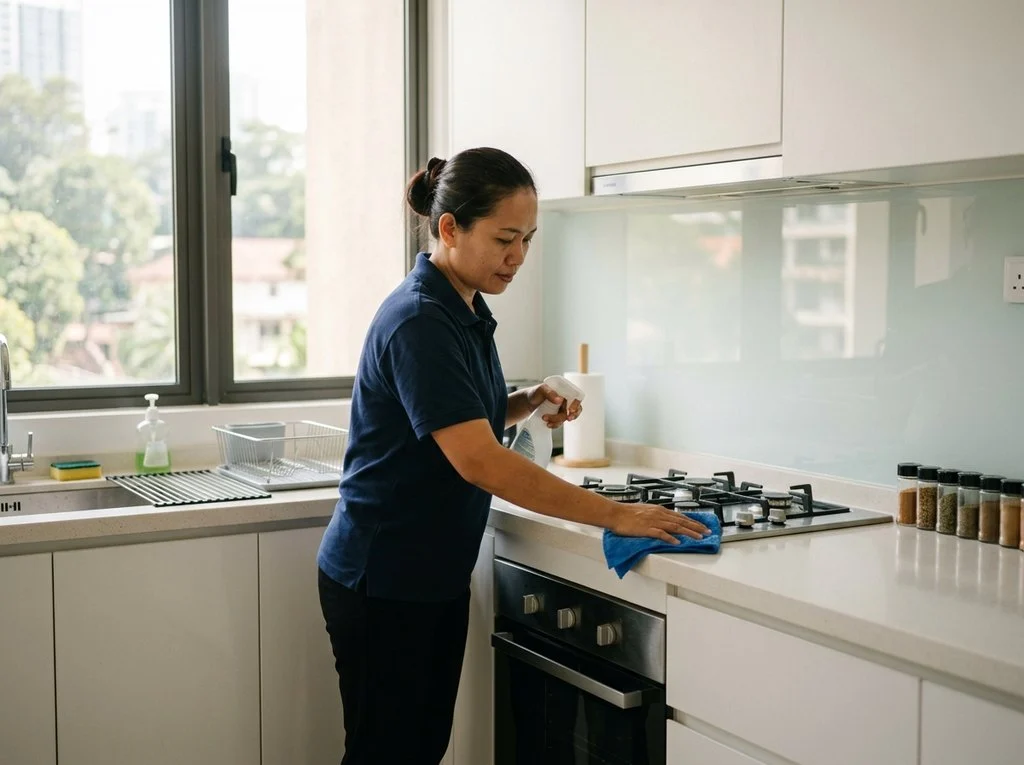
Scope varies by provider, so it’s worth confirming before booking, but a typical standard session covers: sweeping and mopping floors (living areas, bedrooms, and any balcony or car porch), dusting surfaces and furniture, kitchen counter/sink/stove wipe-down and cabinet exteriors, bathroom cleaning (toilet, sink, mirror, shower fixtures), wiping windows/fans/doors/skirting, and general tidying plus rubbish disposal. It usually does not automatically include: ironing, fridge or cabinet interiors, deep scrubbing of stubborn stains, or specialty items like sofa, mattress, or carpet cleaning — these are commonly offered as separate add-ons or dedicated services (see sofa cleaning, carpet cleaning, and mattress cleaning if those are what you actually need) rather than baked into a standard session’s base price.
Confirming scope upfront — a quick message describing your home and what you want covered is usually enough — avoids the most common source of first-booking disappointment: assuming “cleaning service” means the same thing to every provider. If your home has heavy grease buildup, stubborn old stains, or is fresh off a renovation, that’s generally a sign you need deep cleaning or post-renovation cleaning rather than a standard session — see the comparison above.
How to Verify a Cleaning Company Is Actually Registered in Malaysia
This is the one genuinely concrete step most “how to choose a cleaning service” advice skips. Rather than relying only on reviews, you can check whether a company is a real, registered business in under a minute using Malaysia’s official company registry:
- Go to the SSM e-Search portal at ssm.com.my/Pages/e-Search.aspx — this is the Companies Commission of Malaysia’s own official lookup tool.
- Search by the company’s registered name or its registration number (format varies depending on whether it registered before or after 2019).
- Confirm the status shows Active (not “Wound Up” or “Struck Off”), and check whether it’s registered as a Sdn Bhd, sole proprietorship, partnership, or LLP.
Worth knowing: an “Active” SSM status confirms the business is legally registered, but it doesn’t by itself confirm insurance coverage, staff vetting standards, or service quality — those are still worth asking about directly. But it’s a genuine, five-minute way to rule out an entirely unregistered or defunct entity before you hand over your address and a booking date.
Are Cleaning Products Safe for Kids and Pets?
“Eco-friendly” or “non-toxic” claims on a cleaning company’s marketing aren’t independently regulated in a way that guarantees much on their own — it’s a reasonable question to ask directly what products a provider uses, whether they’re fragrance-free/low-VOC options, and whether the company can accommodate a request to avoid a specific product (bleach-based cleaners, for instance) if a household member has respiratory sensitivities or allergies. A provider that can answer this specifically, rather than just saying “yes, safe,” is generally a good sign.
There’s also a practical, KL-specific wrinkle worth knowing: cleaning normally means opening windows for ventilation while surfaces dry and fumes clear, which is good practice on a normal day but worth reconsidering during a haze episode (see the API readings above) — on days when the Air Pollutant Index is elevated, ask your provider whether they can keep windows closed and rely on fans/air circulation instead, particularly if anyone in the household is in a higher-risk group.
Frequently Asked Questions
How much does a standard cleaning session cost in KL?
Typically RM80–RM200 depending on property size, per Dig This Design’s Kuala Lumpur cleaning cost breakdown. Deep cleaning runs higher, generally RM300 and up. At Top Clean & Clear, a standard session is a flat RM130 for 4 hours, with no advance payment — you inspect the completed work and pay afterward. That rate assumes you supply basic cleaning products yourself; if you’d rather the cleaner bring their own tools and products, that’s a RM55 add-on. Full scope is on the house cleaning service page.
How often should I clean my KL home?
Weekly is the general baseline recommended by the American Cleaning Institute for allergen control, and it’s a reasonable fit for KL given the region’s consistently high humidity (80–88% average, per MetMalaysia) — well above the 60% threshold the US EPA flags for mould risk. Consider more frequent light cleaning during haze episodes.
What’s the difference between standard and deep cleaning?
Standard cleaning is routine weekly/biweekly upkeep; deep cleaning is a more thorough, less frequent pass that reaches areas a standard clean skips (behind appliances, skirting, built-up grime). See the comparison table above.
Do I need to be home during the cleaning?
This depends entirely on the provider’s policy and your own comfort level — some customers prefer to be present for the first session and arrange key access or a trusted-entry method afterward. Ask directly what your provider’s standard practice is. Top Clean & Clear’s booking runs over WhatsApp: you agree the date, address, and access arrangement in advance, the cleaner arrives within the agreed window, and — because payment happens after you inspect the finished work together — being reachable to do that walk-through near the end of the session is part of how the pay-after-service model works, even if you don’t need to be home the entire time.
How do I know if a cleaning company in KL is a legitimate, registered business?
Search the company’s name or registration number on Malaysia’s official SSM e-Search portal and confirm the status shows “Active.” This is a free, official check that takes under a minute.
Do I need to provide my own cleaning supplies and equipment?
This varies by provider — some bring their own equipment as part of the base price, others offer it as a paid add-on, and some expect you to supply basics. Confirm this specifically when booking, since it affects both the final price and what you need to have ready. At Top Clean & Clear, the default RM130 rate assumes you provide basic supplies; the cleaner bringing their own tools and products instead is a separate RM55 add-on, so you can pick whichever suits you when you message them on WhatsApp to book.
Can I request the same cleaner for every visit?
Many providers will try to assign the same cleaner to a recurring booking, subject to availability, since it tends to mean faster sessions once the cleaner knows your home’s layout and preferences. If consistency matters to you, ask about this directly before committing to a recurring schedule. Top Clean & Clear’s part-time maid service documents this explicitly — the same cleaner where availability allows — so it’s a reasonable thing to ask about for a recurring standard house-cleaning booking too, even though it isn’t spelled out the same way on that specific service page.
In Short
Cleaning services in KL typically run RM80–RM200 for standard sessions, and weekly cleaning is a reasonable default given the region’s genuinely high year-round humidity — not just a generic recommendation. Before booking anyone, a free SSM registration check takes less time than reading a page of reviews. If you want to see what a real local standard-cleaning session actually includes, Top Clean & Clear’s house cleaning service lays out the full scope and current RM130 rate.